

AI Security Architecture for the Enterprise
Building secure AI systems requires architecture decisions that address risks specific to machine learning pipelines, large language model deployments, and agentic AI systems. GDF's security architects work with enterprise teams to design and assess AI deployments that are secure by design, governable in practice, and aligned with applicable compliance requirements including NIST AI RMF, ISO 42001, and the EU AI Act.
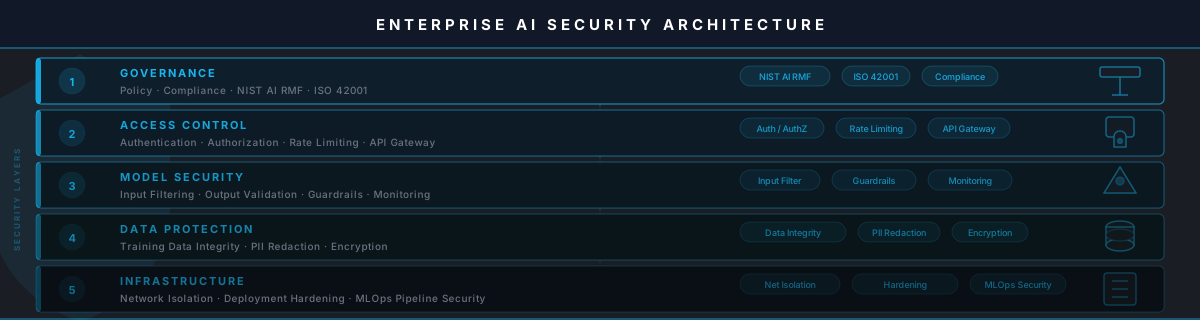

Secure AI Deployment Architecture
The architecture decisions made when deploying an AI system determine its attack surface for the entire deployment lifecycle. Organizations that deploy LLMs without a security architecture review routinely introduce vulnerabilities that are far more difficult to remediate after deployment than before: overprivileged service accounts, unsegmented model inference endpoints, system prompts that can be extracted through standard API access, and tool integrations that allow an injected model to reach production data stores.
GDF's secure AI deployment architecture work addresses the foundational security controls that every enterprise LLM deployment should implement. Model isolation ensures that inference compute runs in an appropriately segmented environment, with network controls that prevent the inference service from making unauthorized outbound connections. API gateway security wraps the model inference endpoint with authentication, authorization, rate limiting, and logging controls appropriate to the sensitivity of the application and the trust level of its users. Input and output filtering layers validate incoming requests and outgoing responses against policy rules, providing a defense-in-depth layer between the raw model and its users.
For multi-tenant AI deployments, GDF assesses and designs the tenant isolation controls that prevent one organization's data, prompts, and conversation history from being accessible to another. This includes namespace isolation in vector databases, session management controls that enforce context boundaries, and access control models that apply to both user-facing interfaces and administrative APIs. In environments where the AI system processes data subject to regulatory requirements, GDF designs the data handling architecture to ensure that sensitive data is retained, processed, and deleted in accordance with applicable requirements.
GDF also assesses the network architecture surrounding AI deployments: the placement of inference services relative to corporate networks and the public internet, the controls on traffic between AI components (retrieval services, tool APIs, orchestration layers), and the monitoring and logging infrastructure needed to detect and respond to security events. For organizations using third-party AI APIs, GDF reviews the security implications of sending organizational data to external inference endpoints and designs controls to minimize exposure.
LLM Governance Frameworks
A governance framework for enterprise LLM deployment defines the policies, processes, and accountability structures that determine how AI systems are approved for use, how they are monitored in production, and how security and safety issues are identified and addressed. Without a governance framework, enterprise AI deployments accumulate risk at the speed of adoption: every new AI tool integrated without security review, every system prompt written without oversight, and every data connection added without authorization review represents unmanaged exposure.
GDF's LLM governance framework work addresses the organizational and technical dimensions of governance together. On the organizational side, this includes defining roles and responsibilities for AI system security, establishing a review and approval process for new AI deployments and significant changes to existing ones, and creating escalation paths for security findings and incidents. On the technical side, this includes access control design that enforces role-based permissions on AI system capabilities, audit logging that captures the information needed for security review and incident response, and data loss prevention controls that detect and prevent unauthorized disclosure of sensitive information through AI interfaces.
Monitoring and observability are critical governance components that many organizations underinvest in for AI systems. Unlike conventional application logs, which capture discrete transactions with defined inputs and outputs, LLM application logs must capture enough conversation context to support security analysis without themselves becoming a data liability. GDF designs monitoring architectures that give security teams visibility into model behavior, prompt patterns, and anomalous usage without requiring storage of full conversation histories containing sensitive user data.
System prompt management is a governance challenge that receives insufficient attention in most enterprise AI programs. System prompts are effectively security policy documents: they define what the model will and will not do, what data it will access, and how it will respond to adversarial inputs. GDF establishes version control, review, and approval processes for system prompt management, treating system prompts with the same rigor applied to security policy documentation.
AI Risk Assessment and Threat Modeling
GDF's AI risk assessment and threat modeling methodology adapts established threat modeling frameworks (STRIDE, PASTA, attack tree analysis) for the specific characteristics of AI systems. A conventional threat model identifies code components, data flows, and trust boundaries. An AI threat model must additionally address the model itself as an attack surface: the training data pipeline, the model weights, the inference environment, the prompting interface, and every external data source the model consumes.
The threat modeling process begins with architectural decomposition: mapping every component in the AI system from data ingestion through inference to output delivery. For each component, GDF identifies the assets it holds or processes, the threats applicable to it, and the existing controls that address those threats. The output is a prioritized list of threat scenarios with associated risk ratings, attack path analysis showing how an adversary could move from initial access to the target impact, and control gap analysis identifying where existing controls are absent or insufficient.
Attack surface mapping for LLM applications covers the interfaces through which adversaries can interact with the system: the user-facing prompt interface, any document or data upload capabilities, API endpoints, model management interfaces, training data pipelines, and any external integrations the model uses. For each interface, GDF identifies the threat actors who can access it (unauthenticated users, authenticated users, privileged operators, insiders, supply chain actors), the attacks they could mount, and the impact if those attacks succeed.
GDF's AI threat models include specific adversarial scenarios relevant to the client's deployment context, rather than generic risk categories. For a legal research AI with access to privileged documents, the relevant scenarios include attempts by opposing counsel to extract privileged content, insider extraction by departing employees, and injection attacks through documents filed in litigation. For a customer service AI with access to account data, the relevant scenarios include account takeover facilitated by AI-assisted social engineering, data extraction by competitors, and manipulation of the AI to authorize unauthorized transactions. This specificity makes threat models actionable rather than theoretical.
Secure RAG Implementation
Retrieval-augmented generation has become the standard architecture for enterprise AI applications that need to draw on organizational knowledge bases, customer data, or document repositories. The security of a RAG implementation determines whether the AI system enforces the same access controls as the underlying data systems, or whether it creates a new pathway to access data that bypasses those controls entirely.
GDF's secure RAG architecture addresses security at each stage of the retrieval pipeline. Vector database security covers access control at the namespace level, ensuring that each user or user group can only retrieve embeddings from documents they are authorized to access. For multi-tenant deployments, this requires namespace isolation controls that prevent cross-tenant retrieval, verified through testing of the kind GDF conducts in its AI security testing engagements. Embedding integrity controls verify that the vector representations stored in the database correspond to the documents they claim to represent, detecting embedding poisoning attacks that could cause the retrieval system to return manipulated content.
The document ingestion pipeline requires security controls at the intake stage. Documents submitted for indexing may contain malicious instructions designed to influence the model when those documents are later retrieved, an attack known as indirect prompt injection through the retrieval layer. GDF designs ingestion pipelines with sanitization controls that identify and neutralize injection attempts before documents are indexed. For high-sensitivity document repositories, GDF recommends human review workflows for documents originating from untrusted sources before they enter the retrieval index.
Retrieval controls define what the model does with retrieved context: whether retrieved documents are presented to the user alongside AI responses, whether the model is constrained to answer only from retrieved context, and how conflicts between retrieval results and the model's training are handled. GDF designs these controls to minimize the attack surface of the retrieval interface while maintaining application utility.
AI Supply Chain Security
Enterprise AI deployments depend on a supply chain that includes base model providers, fine-tuning infrastructure, embedding model providers, vector database vendors, orchestration frameworks, and a growing range of AI plugins and integrations. Each component in this supply chain represents a potential point of compromise that could affect the security of the entire AI system.
Model provenance is the foundational supply chain security control: verifying that the model weights used in production are the weights that the provider published, have not been modified in transit or storage, and were trained on data consistent with the provider's claims. GDF establishes provenance verification processes for enterprise AI deployments, including cryptographic hash verification of model weights, review of model cards and training documentation, and evaluation of provider security practices for organizations deploying models from external sources.
Fine-tuning security addresses the risk that adversaries could influence an organization's fine-tuning process to introduce backdoors or biases into customized models. GDF reviews fine-tuning data pipelines for integrity controls, assesses whether training data sources are adequately vetted, and evaluates the access controls on fine-tuning infrastructure. For organizations that fine-tune models on sensitive data, GDF designs data handling controls that prevent training data from being extractable through the fine-tuned model.
Third-party model and plugin evaluation is a supply chain security requirement that organizations with mature AI programs conduct before deploying any externally developed AI component. GDF's evaluation process assesses the security documentation published by the vendor, tests the component's behavior against relevant security scenarios, and evaluates the data handling implications of integrating the component into the organization's AI environment. This evaluation produces a risk-rated finding set that supports procurement and integration decisions.
MLOps Security
Machine learning operations (MLOps) encompasses the CI/CD pipelines, infrastructure automation, model versioning systems, and deployment tooling that manage the AI lifecycle from development through production. These systems have become high-value targets because a compromise of the MLOps pipeline can affect every model that flows through it, giving an adversary the ability to influence model behavior at scale.
GDF's MLOps security assessments cover the full pipeline from training data intake through production deployment. CI/CD pipeline hardening reviews the access controls, secrets management, and artifact integrity verification applied to ML pipelines, with specific attention to the points at which training data, model weights, and deployment configuration could be tampered with. Model versioning and registry security ensures that model artifacts are signed, that version history is immutable, and that the registry access controls prevent unauthorized model substitution.
Deployment security covers the controls applied when a model is promoted from development through staging to production: approval workflows, automated security testing requirements, rollback procedures, and the access controls on deployment tooling. GDF reviews these controls against the principle that a model deployment is a security-relevant change that should require the same rigor as a software release, with auditability sufficient to reconstruct exactly which model version was deployed when and by whom.
Secrets management in ML pipelines is a frequent weakness: API keys for training data sources, model registries, cloud GPU providers, and inference APIs often end up hardcoded in training scripts, stored in unencrypted configuration files, or exposed in model artifacts. GDF audits secrets handling in MLOps environments and designs remediation that integrates secrets management tooling appropriate to the pipeline architecture.
Compliance Architecture
AI compliance requirements are evolving across multiple jurisdictions and sectors. GDF's AI security architecture work addresses the technical architecture requirements imposed by the primary frameworks currently in force or imminent.
NIST AI RMF alignment requires organizations to establish governance structures, risk assessment processes, and technical controls across the Govern, Map, Measure, and Manage functions. The technical architecture requirements of the AI RMF include implementing controls appropriate to the risk tier of the AI system, maintaining documentation of AI system characteristics and known limitations, and establishing monitoring and evaluation processes that support ongoing risk management. GDF designs AI system architectures that incorporate these requirements from the outset, and assesses existing deployments against AI RMF requirements to identify gaps.
ISO 42001 readiness addresses the requirements of the international AI management system standard. Organizations pursuing ISO 42001 certification must demonstrate that they have implemented an AI management system with defined scope, policy, objectives, and processes including AI risk assessment, treatment, and continuous improvement. GDF's architecture assessments produce gap analyses against ISO 42001 requirements and recommend the technical controls and process changes needed to close identified gaps.
EU AI Act architecture compliance addresses the technical documentation, cybersecurity measure, logging, and robustness requirements for AI systems classified as high-risk under the Act. GDF's architecture work for EU AI Act compliance focuses on designing the audit logging infrastructure, robustness testing regime, and technical documentation processes needed to support conformity assessment and ongoing compliance obligations.
GDF also addresses sector-specific AI compliance requirements: SR 11-7 model risk management for financial institutions, FDA guidance on AI/ML-based software as a medical device for healthcare, and federal AI acquisition and security requirements for government contractors. Contact GDF at 1-800-868-8189 to discuss the compliance architecture requirements specific to your sector and deployment context.
AI Incident Response Planning
AI security incidents require incident response procedures adapted to the specific characteristics of AI systems. A compromised model may not produce the discrete error signals that trigger conventional incident response playbooks. Instead, the indicators of compromise may be subtle behavioral changes: answers that are systematically biased in a specific direction, unusual data disclosure patterns, unexpected tool calls, or outputs that suggest the model has been given additional instructions through an injection attack.
GDF's AI incident response planning work addresses the detection, containment, and forensic documentation procedures specific to AI security events. Detection architecture for AI incidents requires behavioral monitoring that can identify anomalous model behavior, not just infrastructure-level security events. GDF designs monitoring rules and alert thresholds based on the specific application's expected behavior, so that deviations from normal patterns generate alerts that security teams can triage.
Containment procedures for compromised AI systems differ from conventional incident response because the "patch" for an AI security issue may require prompt modifications, retrieval index changes, tool permission revocations, or model rollback to a prior version, depending on the nature of the compromise. GDF documents runbooks for each plausible incident type, specifying the isolation steps needed to stop an active incident, the evidence preservation steps needed to support post-incident analysis, and the recovery steps needed to restore the system to a secure state.
Forensic documentation for AI incidents must capture evidence in forms that support subsequent analysis: conversation logs with sufficient context to reconstruct the attack sequence, model version information, system prompt versions, tool invocation logs, and retrieval query logs. GDF designs logging architectures that capture this evidence automatically during normal operation, so that incident response teams have the forensic record they need without relying on evidence that may have been overwritten before an incident was detected.
GDF's AI security architecture and incident response planning engagements serve organizations across financial services, healthcare, legal, government, and technology sectors. Our analysts hold relevant security certifications and maintain current expertise in AI security. Contact GDF at 1-800-868-8189 for a confidential consultation.
Architecture Services
- Secure AI Deployment Design
- LLM Governance Frameworks
- AI Threat Modeling
- Attack Surface Mapping
- Secure RAG Architecture
- Vector Database Security
- AI Supply Chain Review
- Model Provenance Verification
- MLOps Security
- CI/CD Pipeline Hardening
- Secrets Management
- NIST AI RMF Alignment
- ISO 42001 Readiness
- EU AI Act Compliance
- AI Incident Response Planning
- Audit Logging Design
Last updated: April 14, 2026
AI Threat Modeling
GDF maps the full AI attack surface from training pipelines through inference endpoints, producing prioritized threat scenarios and control gap analysis specific to your deployment.
Secure RAG Design
GDF designs retrieval-augmented generation architectures with vector database access controls, namespace isolation, and ingestion sanitization that enforce intended authorization boundaries.
Compliance Alignment
Architecture assessments and recommendations are mapped to NIST AI RMF, ISO 42001, and EU AI Act requirements, supporting certification and regulatory submissions.
AI Incident Response
GDF designs detection, containment, and forensic documentation procedures for AI security incidents, including logging architectures that capture the evidence needed for post-incident analysis.
AI Security Architecture Review Framework
Request a Consultation
All consultations are strictly confidential. GDF works with security architecture and engineering teams to design AI deployments that are secure, governable, and compliant.