

Source Code Security Review
GDF's certified security analysts perform thorough, manual source code security reviews for law firms, corporations, and government agencies. We identify vulnerabilities, backdoors, undisclosed logic, and exploitable flaws that automated scanners miss, producing court-admissible technical findings attorneys can rely on.
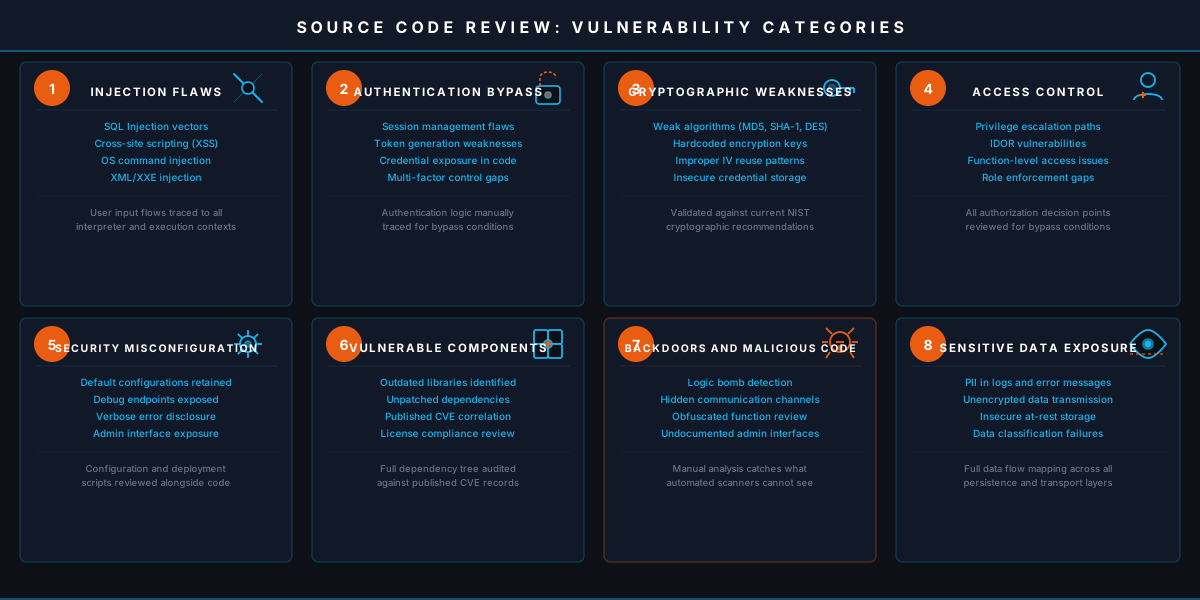

What a Source Code Security Review Covers
A source code security review is a methodical, line-by-line forensic examination of application source code to identify security defects, malicious constructs, undisclosed logic, and coding patterns that create exploitable conditions. Unlike automated static analysis tools, which flag syntactic patterns without understanding intent or context, GDF's analysts read, reason about, and document code the way an adversary or expert witness would: with human judgment applied to every finding.
GDF's source code reviews address application security concerns across the full stack, including:
- Injection vulnerabilities: SQL injection, command injection, LDAP injection, XML injection, and template injection across all major languages and frameworks
- Authentication and session management flaws: weak credential storage, insecure token generation, session fixation, and broken logout logic
- Access control defects: missing authorization checks, privilege escalation paths, insecure direct object references, and function-level access control failures
- Cryptographic weaknesses: use of deprecated algorithms, hard-coded keys, insufficient key length, insecure random number generation, and improper certificate validation
- Backdoors and intentional malicious logic: undocumented administrative interfaces, hidden credential checks, logic bombs, time-triggered payloads, and data exfiltration routines
- Third-party and open-source component risk: known-vulnerable library versions, license compliance issues, and supply chain tampering indicators
- Data handling deficiencies: plaintext storage of sensitive data, logging of credentials or PII, insecure data transmission, and missing input sanitization
- Business logic flaws: race conditions, transaction integrity failures, improper workflow enforcement, and privilege boundary violations specific to the application's function
Reviews are conducted across all major languages including Java, C, C++, C#, Python, JavaScript and Node.js, PHP, Ruby, Go, Swift, Kotlin, and Rust. GDF analysts are also experienced with embedded firmware code, proprietary scripting languages, and compiled binary analysis where source is unavailable.
GDF's Code Review Methodology
GDF's source code security reviews follow a structured, repeatable methodology built on the forensic principle that every finding must be documentable, reproducible, and defensible before a federal court, arbitration panel, or technical audience. The process begins with scoping: GDF works with client counsel or technical teams to define the codebase under review, the application's purpose and trust boundaries, and the specific questions the review must answer. For litigation matters, this typically means confirming that specific vulnerabilities existed at a particular point in time, establishing whether a backdoor was intentionally inserted, and tracing whether a third party's code introduced the conditions that led to a breach.
The review proceeds in three phases. In the reconnaissance phase, analysts map the application's architecture: entry points, authentication boundaries, data flows, third-party dependencies, and build configuration. This produces a threat model that guides the depth of manual review in each subsystem. High-risk areas receive proportionally greater attention, while the full codebase receives a baseline pass for gross defects.
In the analysis phase, analysts conduct manual code reading supplemented by static analysis tooling. GDF uses industry-standard SAST tools including Semgrep, Checkmarx, Veracode, and Fortify as a force multiplier. For embedded and IoT firmware code, see our IoT security assessment services., but every flagged finding is manually triaged and verified. False positives are eliminated; true positives are documented with precise source file, line number, exploit scenario, and remediation guidance. Novel or complex findings, particularly those involving multi-step exploit chains or intentionally obfuscated logic, receive extended manual analysis.
In the reporting phase, GDF produces a technical report structured for two audiences. The technical appendix contains every finding with full code context, reproduction steps, severity rating (using CVSS v3.1 scoring), and recommended remediation. The executive summary and attorney-facing sections explain the significance of each finding in plain language, suitable for inclusion in legal filings, expert reports, or regulatory submissions. All findings are documented with chain-of-custody information sufficient for federal court admission. Version-controlled codebases are examined with commit history preserved, and GDF analysts document the exact repository state reviewed so that opposing parties cannot dispute the scope of analysis.
Source Code Review in Litigation and Due Diligence
Source code security reviews appear across a growing set of legal and business contexts. In software licensing and intellectual property disputes, GDF analysts examine code to identify unauthorized use of proprietary algorithms, misappropriated trade secrets embedded in a competitor's product, or licensing violations involving open-source components. GDF's analysis has supported claims under the Defend Trade Secrets Act in federal courts across multiple districts, as well as state trade secret statutes in California, New York, Texas, and beyond. Where a breach is also involved, GDF coordinates source code review with the cybersecurity incident response team.
In data breach litigation and regulatory proceedings, code review establishes whether a vulnerability was present in deployed software at the time of a breach, whether the developer had prior notice of the defect, and whether standard of care was met. These findings directly inform claims of negligence, breach of contract, and violations of the FTC Act, HIPAA, GLBA, and state breach notification statutes. GDF experts have supported breach litigation in federal district courts and before state attorneys general.
In merger and acquisition due diligence, acquirers engage GDF to assess the security posture of target company software before finalizing terms. A source code review at this stage identifies vulnerabilities that could represent material liabilities, compliance gaps that could require remediation investment, and technical debt that affects valuation. GDF's due diligence engagements are structured to produce findings that can feed directly into reps-and-warranties insurance underwriting and post-closing indemnification negotiations.
In vendor disputes and software escrow matters, GDF provides neutral third-party code analysis when parties disagree about whether delivered software meets contractual specifications, contains known defects, or matches the escrowed version. GDF's reports are structured to support arbitration or litigation without requiring disclosure of trade secrets to opposing parties, using appropriate protective order frameworks.
GDF serves clients across all 50 states and maintains international capability through partner relationships in Europe, Asia, and Latin America. Our certified analysts hold CCE, EnCE, ACE, GIAC, and CCFE credentials recognized by federal and international courts. Every engagement is handled under strict confidentiality, with formal engagement letters available on request.
Last updated: April 14, 2026
Litigation Support
GDF analysts produce court-admissible reports and provide expert witness testimony in federal and state proceedings involving software defects, trade secret theft, and data breach liability.
Backdoor Detection
When malicious or unauthorized logic is suspected in delivered software, GDF conducts forensic examination to document its presence, origin, and intended function with evidentiary rigor.
M&A Due Diligence
Pre-acquisition code reviews identify security liabilities and technical debt in target company software, giving buyers the technical foundation for informed negotiations and risk allocation.
Regulatory Compliance
GDF's findings support submissions to regulators including the FTC, HHS OCR, state attorneys general, and international data protection authorities where software security is at issue.
Request a Consultation
All consultations are strictly confidential. We'll assess your situation and recommend the right forensic approach.
Application Security Testing
Source code review is one component of a complete application security program. Organizations that need to validate the security of deployed applications, identify vulnerabilities in running software, assess open-source dependency risk, and integrate security testing into their development pipeline require a broader set of testing services. GDF provides the complete application security testing methodology set, delivered with the forensic documentation standards required when findings must support legal proceedings, regulatory submissions, or executive risk decisions.
Static Application Security Testing (SAST)
Static application security testing analyzes application source code, bytecode, or compiled binaries without executing the application. SAST identifies vulnerabilities in the code itself: injection flaws, authentication weaknesses, insecure cryptographic implementations, hardcoded credentials, and unsafe API usage that will be present in every deployment of the application regardless of its runtime configuration.
GDF's SAST approach combines automated analysis tools with manual review to address the principal limitation of automated SAST: high false-positive rates that reduce the signal-to-noise ratio of findings to the point where development teams stop acting on them. GDF uses industry-standard tools including Semgrep, Checkmarx, Veracode, and Fortify as an initial screening pass to identify candidate findings across large codebases. Every flagged finding is then manually triaged by a GDF analyst to verify exploitability, eliminate false positives, and add the contextual analysis that explains why the finding represents a real security risk rather than a syntactic pattern match.
Manual SAST also identifies vulnerability classes that automated tools cannot detect: complex multi-step vulnerability chains where each individual code pattern is benign in isolation, business logic flaws that require understanding of the application's intended behavior, and intentional malicious logic that is designed to evade automated detection. For software involved in litigation, insurance claims, or regulatory proceedings, manual SAST produces findings with the level of technical detail and documentation rigor needed to withstand adversarial scrutiny.
Dynamic Application Security Testing (DAST)
Dynamic application security testing examines a running application by sending requests to its interfaces and analyzing responses for security vulnerabilities. Where SAST identifies vulnerabilities in code, DAST identifies vulnerabilities in the deployed, running application, including those introduced by configuration, deployment environment, and runtime dependencies that are not visible in source code alone.
GDF's DAST engagements begin with application reconnaissance: mapping every endpoint, parameter, and functionality accessible through the application's interfaces. This mapping ensures that testing coverage is complete and that findings are presented with accurate endpoint context. For web applications, this covers all HTTP methods, authentication-protected endpoints accessible with test credentials, API endpoints documented and undocumented, and file upload and processing functionality. For mobile applications, DAST covers the application's network communications in addition to the interfaces exposed by any server-side components.
Automated DAST scanning using tools such as Burp Suite Pro, OWASP ZAP, and Nuclei provides broad coverage of common vulnerability classes including injection points, authentication bypass vectors, and security header deficiencies. Manual DAST testing by GDF analysts addresses the application's specific functionality: testing business logic flows for race conditions and authorization failures that automated tools cannot identify, testing complex authentication sequences, and following up on automated findings that require manual confirmation or chaining with other findings to achieve meaningful impact.
DAST findings are presented with complete reproduction evidence: the exact HTTP requests and responses that demonstrate the vulnerability, the authentication context required to reach the vulnerable endpoint, and the impact that would result from exploitation. This documentation supports both developer remediation and any legal or regulatory use of the findings.
Interactive Application Security Testing (IAST)
Interactive application security testing instruments the application at runtime to observe security-relevant behavior from inside the execution environment. Unlike DAST, which examines the application's external interfaces, IAST monitors internal code execution paths, data flows, and API calls as the application processes requests. This provides vulnerability detection with the accuracy of static analysis (because the analysis occurs at the code level) and the coverage of dynamic testing (because it only analyzes code that actually executes during the test session).
GDF deploys IAST using agent-based instrumentation frameworks compatible with Java, .NET, Python, Node.js, and Ruby applications. During a test session, the IAST agent records data flows from user-controlled input through the application's processing logic to any sink that could represent a vulnerability: database queries, operating system commands, file system operations, external HTTP calls, and serialization operations. Findings are correlated with the exact source code location and execution path, providing the level of precision needed to prioritize remediation without manual triage.
IAST is particularly effective for identifying vulnerabilities in complex applications where the code paths that handle user input are difficult to trace statically. In multi-tier applications where data passes through multiple services before reaching a vulnerable sink, IAST tracks the data flow across service boundaries, identifying injection vulnerabilities that would require manual analysis of multiple codebases to find through SAST alone.
Software Composition Analysis (SCA)
Modern applications include a significant proportion of open-source and third-party components: libraries, frameworks, SDKs, and container base images that may comprise the majority of the application's executable code. These components introduce both security risk (known vulnerabilities in dependency versions that the organization has not updated) and legal risk (license obligations that the organization may not be meeting). GDF's software composition analysis identifies and assesses both dimensions.
GDF's SCA process generates a software bill of materials (SBOM) for the assessed application, identifying every direct and transitive dependency with its exact version. This inventory is checked against multiple vulnerability databases including the National Vulnerability Database (NVD), GitHub Advisory Database, and vendor-specific advisories to identify components with known vulnerabilities. Findings are prioritized by exploitability (is the vulnerable code path reachable in this application's deployment context?) and severity (what is the potential impact if the vulnerability is exploited?), not simply by CVSS score.
For organizations involved in M&A transactions, SCA findings on the target company's software identify dependency-related security liabilities that should be considered in valuation and indemnification negotiations. For organizations subject to supply chain security requirements under NIST SP 800-161, Executive Order 14028, or sector-specific frameworks, GDF's SCA provides the SBOM documentation and vulnerability assessment that these requirements mandate. For software involved in breach litigation, SCA findings establish whether known-vulnerable dependencies were present in the deployed version at the time of the incident.
API Security Testing
APIs are the primary interface through which modern applications exchange data and invoke functionality. They are also the primary attack surface in a majority of application security incidents. GDF's API security testing applies the OWASP API Security Top 10 framework to identify the vulnerability classes most commonly exploited in API-focused attacks: broken object-level authorization, broken authentication, excessive data exposure, lack of resource and rate limiting, broken function-level authorization, mass assignment, security misconfiguration, injection, improper asset management, and insufficient logging and monitoring.
Testing covers REST APIs, GraphQL APIs, SOAP web services, gRPC services, and proprietary API protocols. For each API surface, GDF tests authentication controls (including token handling, key management, and OAuth implementation quality), authorization enforcement (verifying that each endpoint enforces appropriate access controls and does not permit horizontal or vertical privilege escalation), input validation (testing each parameter for injection vulnerabilities), and data exposure (verifying that responses do not include sensitive fields not required by the requesting client).
GraphQL-specific testing includes introspection abuse (verifying whether schema introspection is disabled in production, preventing attackers from enumerating all available types and fields), nested query depth and complexity limits (testing whether the API enforces controls that prevent resource exhaustion through deeply nested queries), and batching attack resistance (testing whether the API prevents abuse of query batching to bypass rate limiting).
Mobile Application Security Testing
Mobile applications present security risks distinct from web applications, arising from the combination of client-side code that can be reverse engineered, device-level data storage, and network communications that may traverse untrusted networks. GDF's mobile security testing covers both iOS and Android applications using the OWASP Mobile Security Testing Guide (MSTG) as the primary framework.
For Android applications, testing covers APK decompilation and static analysis of Java/Kotlin bytecode and native libraries, manifest analysis for over-permissioned components and exposed intent filters, data storage assessment (checking SharedPreferences, SQLite databases, and external storage for sensitive data stored without encryption), and network communication analysis for certificate pinning implementation and TLS configuration. Dynamic testing on a rooted test device covers runtime analysis of the application's behavior, hooking of security-relevant API calls using Frida, and testing of SSL pinning bypass resistance.
For iOS applications, testing covers IPA extraction and static analysis of Swift and Objective-C binaries, plist file analysis for sensitive configuration data, keychain usage assessment, and binary protection verification (stack canaries, PIE, ARC). Dynamic testing on a jailbroken test device covers runtime behavior analysis, class dumping to identify undocumented functionality, and testing of jailbreak detection mechanisms.
DevSecOps Integration and CI/CD Pipeline Security
Effective application security requires integrating security testing into the development lifecycle rather than treating it as a gate applied before deployment. GDF assists organizations in designing and implementing DevSecOps programs that embed SAST, SCA, and secrets scanning into CI/CD pipelines, ensuring that security findings are identified early in the development process when remediation cost is lowest.
CI/CD pipeline security review examines the build and deployment infrastructure for security weaknesses that could allow an adversary to compromise the software supply chain: unauthorized access to the build environment, pipeline configurations that allow injection of malicious code into build artifacts, insecure handling of secrets such as code signing certificates and deployment credentials, and inadequate artifact integrity verification that could allow a tampered build artifact to reach production.
GDF's DevSecOps integration work produces a security testing architecture tailored to the organization's existing toolchain, recommending specific tools and configurations for SAST (Semgrep, CodeQL, or Checkmarx depending on language stack and existing tooling), SCA (Dependabot, Snyk, or OWASP Dependency-Check), secrets scanning (truffleHog, GitGuardian, or GitHub Secret Scanning), and container image scanning (Trivy, Grype). For organizations that also conduct vulnerability assessments of deployed applications, GDF coordinates application security testing findings with our vulnerability assessment services to ensure that CI/CD findings and deployed application findings are tracked in a unified remediation workflow.
Application Security Testing Coverage
- SAST (Static Analysis)
- DAST (Dynamic Testing)
- IAST (Interactive Testing)
- SCA (Dependency Analysis)
- SBOM Generation
- API Security Testing
- GraphQL Security
- OWASP API Top 10
- iOS Security Testing
- Android Security Testing
- OWASP MSTG Coverage
- DevSecOps Integration
- CI/CD Pipeline Security
- Secrets Scanning
- Container Image Scanning