

Vulnerability Assessment
GDF delivers expert-led vulnerability assessments covering networks, web applications, cloud environments, and enterprise systems. Every finding is manually verified by a certified analyst. Our reports are written for both technical staff and legal teams, with litigation-ready documentation available.
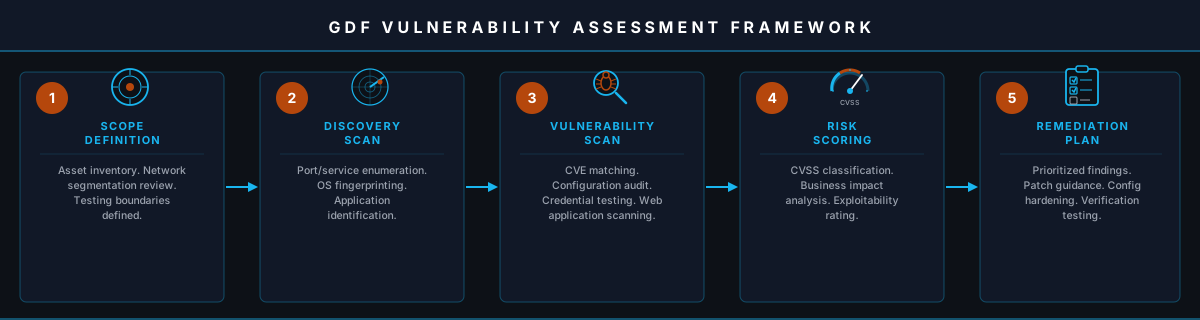

Network Vulnerability Assessment
Network vulnerability assessment is a systematic technical examination of an organization's network infrastructure to identify misconfigured devices, unpatched software, exposed services, and architectural weaknesses that could be exploited by external attackers or malicious insiders. GDF's certified analysts conduct network assessments using a combination of automated discovery tools and manual verification techniques, covering both perimeter-facing and internal network segments.
The assessment begins with asset discovery: GDF maps every reachable host, open port, running service, and identified operating system version across the target network range. This inventory forms the foundation for vulnerability correlation, where GDF analysts compare observed service versions and configurations against current CVE databases, vendor security bulletins, and proprietary intelligence. Every finding is manually verified to confirm exploitability in the specific network context, eliminating the false positives that plague scanner-only assessments.
Network assessment coverage includes:
- External perimeter assessment: internet-facing hosts, firewall rule analysis, exposed management interfaces, public-facing services across all ports
- Internal network assessment: lateral movement risks, trust relationship abuse, unencrypted administrative protocols (Telnet, FTP, unencrypted SNMP), default credentials on network devices
- Network device configuration review: routers, switches, firewalls, VPN concentrators, wireless access points, and load balancers assessed against security baselines
- Active Directory and domain infrastructure: Kerberoasting exposure, AS-REP roasting, unconstrained delegation, legacy protocol enablement (NTLMv1, SMBv1), Group Policy weaknesses
- Cloud network assessment: AWS VPC configurations, Azure NSG rules, GCP firewall policies, public S3/Blob exposure, unrestricted security groups
- Segmentation validation: verification that network zones, DMZs, and OT/IT boundaries enforce intended access controls
GDF's network assessment reports document each vulnerability with its CVE identifier (where applicable), CVSS v3.1 base score, affected asset, proof-of-concept observation, and a prioritized remediation recommendation. Risk ratings account for network context, not just the abstract CVE score, giving security teams an accurate picture of actual organizational exposure.
Application and Web Vulnerability Assessment
Web applications represent the most frequently targeted attack surface in modern enterprises. GDF's application vulnerability assessments evaluate web applications, APIs, and mobile application backends against the OWASP Top 10 and a broader set of application security risks derived from real-world attack patterns. The assessment combines automated scanning with manual testing by analysts who understand how applications are actually exploited, not just what automated tools can detect.
Application assessment scope typically includes authentication and authorization mechanisms, session management, input validation and output encoding, file upload and download handling, API endpoint security, error handling and information disclosure, third-party integrations and OAuth flows, business logic, and client-side security controls. For organizations subject to PCI DSS, HIPAA, or SOC 2, GDF structures assessment scope to align with applicable compliance requirements. Industrial environments require different methodology; see our SCADA security testing services., ensuring assessment findings map directly to control objectives.
GDF's application assessment covers:
- Injection flaws: SQL, NoSQL, LDAP, OS command, XML, and template injection
- Broken authentication: password policy weaknesses, multi-factor authentication bypass, credential stuffing exposure
- Insecure direct object references and broken access control patterns
- Security misconfiguration: exposed admin panels, directory listing, default credentials, verbose error messages, unnecessary HTTP methods
- Cross-site scripting (XSS): reflected, stored, and DOM-based variants
- Using components with known vulnerabilities: outdated JavaScript libraries, server-side frameworks, and CMS platforms
- Sensitive data exposure: unencrypted PII, credit card data, health information in responses, logs, or error messages
- API-specific risks: excessive data exposure, lack of rate limiting, broken object-level authorization, mass assignment, and improper API key management
Application assessments are available as one-time point-in-time assessments or as recurring quarterly engagements that track remediation progress and identify newly introduced vulnerabilities between development cycles.
Assessment Deliverables for Legal and Technical Teams
GDF produces two parallel report streams from every vulnerability assessment engagement. The technical report is a full-detail document containing every verified finding, complete with affected asset identification, vulnerability description, evidence of the condition (screenshots, tool output, packet captures, or configuration excerpts), CVSS scoring rationale, and step-by-step remediation guidance prioritized by risk. This document is suitable for distribution to IT and security engineering staff responsible for remediation.
The executive summary provides organizational leadership and legal counsel with a risk-rated overview of findings, a quantification of the organization's exposure relative to industry peers, and a remediation roadmap with timeline recommendations. This document translates technical risk into business and legal terms, identifying which findings create potential liability under applicable regulatory frameworks including HIPAA, GLBA, PCI DSS, CCPA, NIST Cybersecurity Framework, and SEC disclosure requirements.
For litigation and regulatory matters, GDF offers litigation-ready assessment packages. For organizations running industrial control systems, our OT network assessment applies equivalent rigor to operational technology environments.. These include a formal declaration of methodology, chain-of-custody documentation for assessment artifacts, an expert witness declaration attesting to the accuracy and completeness of findings, and a rebuttal-ready report format designed to withstand opposing expert review. GDF analysts have testified as expert witnesses regarding vulnerability assessment findings in federal and state civil proceedings, insurance coverage disputes, and regulatory enforcement matters.
Post-assessment support is available through GDF's remediation verification service: after client technical teams address identified findings, GDF conducts a focused re-assessment to confirm that vulnerabilities have been fully remediated and that the remediation did not introduce new issues. This verification report provides documentary evidence of remediation suitable for compliance submissions, cyber insurance renewals, and contract performance verification.
GDF serves organizations across all 50 states and internationally, with certified analysts holding CCE, EnCE, ACE, GIAC, ACFEI International, and CCFE credentials. Engagements can be initiated on standard project timelines or on an expedited basis for urgent regulatory, insurance, or litigation deadlines. Call 1-800-868-8189 for immediate consultation.
Last updated: April 14, 2026
Nationwide Coverage
GDF conducts vulnerability assessments for organizations across all 50 states, with remote assessment capability and on-site deployment to any U.S. location.
Expert Witness Support
Assessment findings can be packaged as court-admissible expert witness reports for breach litigation, regulatory proceedings, and insurance coverage disputes.
Compliance Alignment
Assessments are structured to satisfy PCI DSS, HIPAA, NIST CSF, SOC 2, GLBA, and state cybersecurity regulatory requirements where relevant to the engagement.
Remediation Verification
GDF offers post-remediation re-assessment to confirm that identified vulnerabilities have been fully addressed, with a verification report for compliance and legal purposes.
Request a Consultation
All consultations are strictly confidential. We'll assess your situation and recommend the right assessment scope and approach.