

AI Forensics
Artificial intelligence now generates evidence, influences decisions, and creates new categories of fraud at scale. GDF's AI forensics practice addresses the technical questions that courts, regulators, and corporate counsel increasingly face: whether media has been synthetically generated, whether an AI system behaved as represented, whether a machine learning model was misappropriated, and whether algorithmic outputs can be authenticated as evidence.
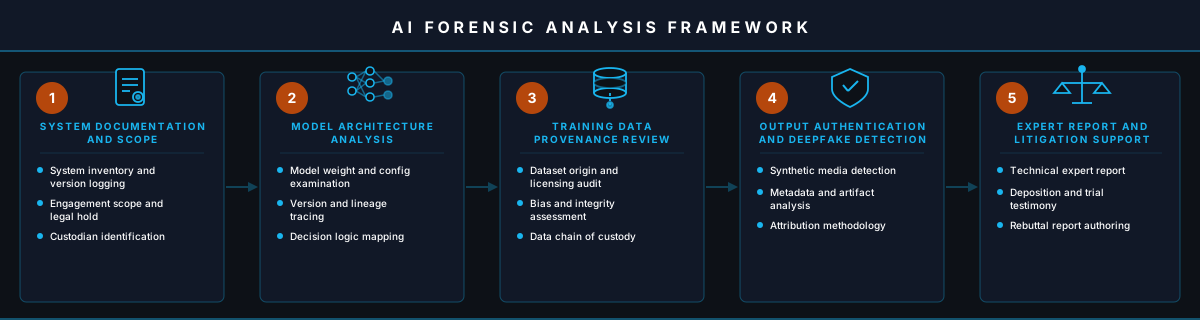

AI Forensics in Practice
The rapid deployment of generative AI across commercial, personal, and government contexts has produced a new class of forensic questions that traditional digital forensics methodology was not designed to address. When a video submitted as evidence may have been face-swapped with a generative model, when an AI hiring system is accused of discriminating on a protected characteristic, when a startup's machine learning model is alleged to incorporate stolen training data, or when an AI-generated contract or communication is introduced in litigation, the courts and the parties need forensic analysis that can speak authoritatively to questions about AI system behavior and AI-generated content.
These are genuinely new forensic challenges requiring both traditional digital forensics rigor and specialized expertise in machine learning systems. The analytical methods applied to deepfake detection, model auditing, and AI attribution draw on computer vision, natural language processing, signal processing, and formal verification, disciplines that overlap with but go beyond conventional digital forensics. GDF's analysts combine these technical capabilities with the documentation discipline and testimony experience that litigation support demands.
AI forensics at GDF covers four primary areas: forensic analysis of AI-generated or AI-manipulated content, auditing of AI systems and their decision-making processes, analysis of AI model intellectual property, and regulatory compliance documentation for AI governance frameworks. For organizations concerned about the security of their AI deployments against adversarial attacks, GDF's AI security testing team addresses those proactive security questions. For the forensic analysis of AI implementations in existing disputes, this practice provides the technical evidence.
Deepfake Detection and Synthetic Media Authentication
Deepfake video, audio, and image generation has moved from research novelty to operational fraud tool in a short period. Synthetic face-swap videos have been used to fabricate compromising recordings of executives, public figures, and individuals in litigation. AI-generated voice cloning has been used to impersonate corporate officers in business email compromise schemes and financial fraud. AI-generated images have appeared as fabricated evidence in legal proceedings. The authentication of multimedia evidence is now a mandatory concern for attorneys handling matters where recordings, photos, or video may have been manipulated.
Video Deepfake Detection
GDF's video authentication analysis applies multiple complementary analytical approaches to characterize the provenance and integrity of video content:
- Physiological signal analysis: Authentic video of human subjects exhibits characteristic patterns of micro-movement in facial features corresponding to cardiovascular activity. Remote photoplethysmography (rPPG) signal analysis detects the absence or distortion of these patterns in synthetically generated faces, which current generative models do not accurately reproduce
- Temporal consistency analysis: Deepfake generation introduces characteristic inconsistencies in facial feature geometry, lighting response, and texture across video frames that differ from the temporal consistency of authentic recordings
- Compression artifact analysis: AI-generated video has distinctive compression artifact patterns in frequency domain representations that differ from the artifact signatures of camera-captured video processed through standard codecs
- Eye and blink analysis: Early deepfake models produced characteristic blink rate anomalies; current models have improved but retain detectable differences in periocular region modeling
- Background and lighting consistency: Face-swap deepfakes frequently exhibit inconsistencies between the lighting model applied to the synthetic face and the environmental lighting present in the background and on other elements in the frame
- Metadata and provenance analysis: File metadata, codec parameters, and digital camera fingerprinting (photo response non-uniformity, PRNU) provide source authentication data independent of content analysis
Audio Deepfake and Voice Clone Detection
AI voice synthesis has advanced to the point where short-duration authentic audio samples can be used to clone a speaker's voice with high perceptual fidelity. GDF's audio authentication analysis examines spectral features of the audio recording to identify synthesis artifacts: the characteristic spectral smoothing, formant transition irregularities, and prosodic pattern deviations that distinguish synthesized speech from authentic recordings of the same speaker.
Where authentic reference recordings of the alleged speaker are available, GDF performs speaker comparison analysis using voice biometric features that are stable across recording conditions and are not accurately replicated by current synthesis models. The analysis documents the similarity or dissimilarity between the questioned recording and the reference samples using quantitative similarity metrics and acoustic feature comparison tables that can be presented as exhibits in proceedings.
Image Synthesis Detection
GAN-generated and diffusion model-generated images exhibit characteristic fingerprints that distinguish them from camera-captured photographs. GDF's image analysis applies frequency domain analysis to identify spectral artifacts characteristic of GAN generation, noise pattern analysis to detect the absence of camera sensor noise signatures expected in authentic photographs, and semantic consistency analysis to identify the spatial relationship anomalies (distorted hands, inconsistent reflections, background feature irregularities) that current generative models continue to produce. For images submitted as documentary evidence, EXIF metadata analysis and source camera fingerprinting supplement the content analysis.
AI Model Auditing
AI model auditing is the systematic technical examination of an AI system to characterize its design, training, behavior, and outputs in relation to specific questions relevant to litigation, regulatory compliance, or dispute resolution. The audit scope varies based on the level of access available: audits of proprietary commercial systems may be limited to behavioral testing through the system's API, while audits of internally developed systems may include examination of model weights, architecture documentation, training pipelines, and version history.
Architecture and Design Review
The architecture review examines the structural design of the AI system: the model type and family (transformer, convolutional neural network, gradient boosted tree, etc.), the number of parameters, the architectural choices that determine what the model can and cannot represent, and the technical documentation produced during the development process. This examination establishes what the system is capable of doing and provides the foundation for understanding why it behaves as it does under specific conditions.
For matters involving AI system liability, the architecture review addresses whether the system was designed in a manner consistent with the state of practice for the application type and the risk level involved. For patent matters involving AI-related inventions, the architecture review documents whether specific claimed structural features are present in the accused implementation.
Behavioral Testing
Behavioral testing applies controlled inputs to the AI system and documents outputs systematically to characterize the relationship between inputs and outputs across the range of conditions relevant to the matter at issue. Testing designs draw on techniques from model evaluation, adversarial machine learning, and fairness testing to produce findings that are both technically comprehensive and directly responsive to the questions the analysis is intended to address.
For AI systems accused of discriminatory outputs, behavioral testing covers the system's output distributions across demographic subgroups using test sets designed to isolate the effect of protected characteristics from legitimate predictive factors. For AI systems accused of producing harmful or fraudulent outputs, testing characterizes the conditions under which those outputs occur and whether the system's developers could reasonably have anticipated them. For AI systems deployed in high-stakes decisions (credit, employment, insurance, healthcare), testing addresses the technical adequacy of the system's design relative to the standards applicable to the deployment context.
Training Data Provenance and Bias Analysis
The training data used to build an AI model fundamentally shapes its behavior. Understanding what data was used, where it came from, how it was collected and labeled, and what demographic characteristics it reflects is essential to understanding why the model performs as it does and whether that performance is appropriate for the application. GDF's training data analysis examines available documentation of data sources, collection methods, and labeling procedures, and applies statistical analysis to characterize the demographic and distributional properties of training datasets where the data itself is accessible.
Algorithmic bias analysis applies to AI systems whose outputs have disparate impacts across demographic groups. GDF documents the statistical basis for bias claims, distinguishing disparate impact attributable to model design choices from disparate impact that reflects real-world distributional differences in the training data, and provides technical findings that attorneys can use to frame discrimination claims or defenses in proceedings before courts, the EEOC, financial regulators, or HUD.
AI Model Intellectual Property Analysis
Machine learning models represent significant intellectual property investment: the architecture design, the training methodology, the curated training data, and the specific trained parameter sets that result from months or years of development. As AI assets have grown in value, the theft and misappropriation of trained models has become a significant concern for AI developers, and a growing category of commercial litigation.
Model Similarity and Theft Detection
When a party alleges that a competitor's AI model was derived from its proprietary model through theft, unauthorized copying, or model extraction attacks, forensic analysis can characterize the structural and behavioral similarities between the models in question. GDF's analysis applies model fingerprinting techniques: examining whether the accused model reproduces the behavioral signatures (including systematic errors, quirks, and unusual output patterns) that distinguish the original model, and whether the model's internal representations exhibit structural similarity at levels inconsistent with independent development.
Model extraction attacks use the API outputs of a target model to train a functionally similar model without accessing the original's parameters. GDF can characterize whether a model's output patterns are consistent with having been produced by extraction from a specific target system, supporting claims under the Defend Trade Secrets Act, Computer Fraud and Abuse Act, and applicable state trade secret laws. For related matters involving theft of source code or training pipelines, GDF's source code review practice can analyze code-level evidence in coordination with the AI forensics analysis.
Training Data Copyright and Provenance
Generative AI models trained on scraped internet content have generated substantial litigation over whether the training process constitutes copyright infringement of the works used as training data. GDF's training data provenance analysis examines whether a model's outputs are consistent with having been trained on specific copyrighted works: whether the model reproduces verbatim or near-verbatim content, whether it reproduces stylistic characteristics traceable to specific authors or works, and what the technical evidence shows about the relationship between the model's outputs and the claimed training material.
This analysis is offered both to copyright holders seeking to establish that their works were used in AI training without authorization, and to AI developers seeking to characterize the relationship between their training data and their model's outputs in defense of copyright claims.
Regulatory Compliance Documentation
AI governance regulation is advancing rapidly at the federal and state levels, and internationally through frameworks including the EU AI Act. Organizations subject to AI regulation need technical documentation of their AI systems' design, training, testing, and operational monitoring that can demonstrate compliance to regulators and auditors. GDF provides third-party technical documentation of AI system compliance with applicable frameworks.
NIST AI Risk Management Framework
The NIST AI Risk Management Framework (AI RMF) provides a voluntary framework for identifying, assessing, and managing risks associated with AI systems across four functions: Govern, Map, Measure, and Manage. GDF's AI RMF compliance documentation examines the organization's AI governance practices, AI risk identification and classification, AI system testing and evaluation records, and ongoing monitoring processes against the AI RMF's outcomes and actions. Findings are presented as a gap analysis with documentation of current compliance posture and specific recommendations for areas requiring additional attention.
ISO/IEC 42001 AI Management Systems
ISO/IEC 42001 establishes requirements for an AI management system (AIMS): the organizational policies, processes, objectives, and controls that govern the responsible development and use of AI. GDF's ISO/IEC 42001 compliance analysis reviews the organization's AIMS documentation against standard requirements, covering AI policy, risk assessment, AI-specific roles and responsibilities, supplier management, incident management for AI systems, and continual improvement processes. This analysis supports certification audits and regulatory demonstrations of AI governance maturity.
SWGDE Multimedia Evidence Guidelines
The Scientific Working Group on Digital Evidence publishes guidelines for the examination of digital multimedia evidence that apply to video, audio, and image evidence whether or not AI manipulation is at issue. GDF's multimedia authentication work follows SWGDE guidelines to ensure that findings are consistent with accepted forensic standards applicable in court proceedings.
Use Cases and Engagements
AI-related disputes are entering the litigation pipeline across several client categories:
Deepfake Evidence Authentication for Law Firms
Attorneys across practice areas are encountering situations where the authenticity of video, audio, or photographic evidence is in question. Criminal defense attorneys need authentication analysis to challenge deepfake evidence introduced by the prosecution. Civil litigants need analysis to challenge or authenticate recordings introduced in employment, defamation, and harassment matters. GDF provides authentication analysis, written reports for motion practice, and expert witness testimony for attorneys who need technical support on multimedia evidence authenticity.
AI System Liability and Negligence
When an AI system makes or influences a consequential decision that causes harm, the technical facts about the system's design, training, and behavior at the time of the relevant decision are central to liability analysis. GDF provides forensic documentation of AI system behavior for product liability matters, professional negligence cases involving AI tools (AI-assisted medical diagnosis, legal AI, financial AI), and regulatory enforcement proceedings. The analysis documents what the system did, under what conditions, and whether that behavior was consistent with the system's documented design and the applicable standard of care.
Insurance Fraud Involving AI-Generated Content
Insurance fraud schemes increasingly use AI-generated images, videos, and documentation to support fraudulent claims. Staged accident photographs generated by AI, synthetically altered damage documentation, and AI-generated injury records present new authentication challenges for claims professionals. GDF provides forensic analysis for insurers, third-party administrators, and law firms handling suspected AI-assisted fraud, producing findings that support claim denial, referral to fraud investigation units, and civil or criminal proceedings against fraudsters.
Corporate AI Governance and Regulatory Audits
Organizations deploying AI in consequential applications face increasing regulatory scrutiny from the CFPB, EEOC, HUD, OCC, and state AI regulators. GDF provides pre-audit compliance documentation, gap analysis against applicable frameworks, and technical support for regulatory examination responses. For organizations that have received regulatory inquiries about their AI systems, GDF works with outside counsel to provide privileged technical analysis that informs the regulatory response.
Standards and Methodology Framework
The practice is governed by applicable professional standards, with clear documentation of methodology and its limitations:
- NIST AI RMF: The NIST AI Risk Management Framework provides the reference structure for AI system risk documentation and compliance analysis
- ISO/IEC 42001: International standard for AI management systems, applied to corporate AI governance compliance documentation
- SWGDE Multimedia Evidence Guidelines: Scientific working group standards for examination of digital video, audio, and image evidence
- ASTM WK96121: The developing ASTM standard for AI governance in forensic science, which GDF monitors and incorporates as it develops
- OECD AI Principles: Human oversight, transparency, accountability, and traceability principles that inform GDF's approach to AI system audit documentation
GDF reports on AI forensics matters explicitly document the methodology applied, the limitations of each analytical technique, and the basis for each finding, following the scientific transparency standards applicable to expert evidence in federal and state court proceedings.
Last updated: April 16, 2026
Deepfake and Synthetic Media Detection
- Video face-swap and face-generation analysis
- Physiological signal and temporal consistency testing
- AI voice clone and audio synthesis detection
- GAN and diffusion model image fingerprinting
AI Model Auditing
- Architecture and design documentation
- Behavioral testing across subgroups and edge cases
- Algorithmic bias and disparate impact analysis
- Training data provenance and dataset characterization
AI IP and Model Theft
- Model similarity and fingerprinting analysis
- Model extraction attack attribution
- Training data copyright provenance analysis
- DTSA and trade secret litigation support
Regulatory Compliance
- NIST AI RMF compliance documentation
- ISO/IEC 42001 AIMS gap analysis
- EEOC, CFPB, and HUD AI audit support
- Expert witness testimony in federal and state courts
Request an AI Forensics Consultation
GDF works with attorneys and corporate counsel on AI authentication, model auditing, and AI system liability matters. All consultations are strictly confidential.