

Automobile (ECU) Forensics
Modern vehicles are networked computers on wheels, storing precise records of speed, braking, steering, location, device connections, and driver behavior. GDF's automobile forensics practice extracts and analyzes data from electronic control units, event data recorders, infotainment systems, and vehicle telematics to produce court-admissible findings for accident reconstruction, insurance matters, civil litigation, and vehicle theft cases nationwide.
The Vehicle as a Digital Evidence Source
The modern automobile generates and stores far more digital data than most parties to litigation, insurance claims, or vehicle theft matters realize. Federal mandates require event data recorders in all light vehicles sold since September 2014. Infotainment systems from every major OEM store navigation history, connected device records, and communication logs. Telematics modules transmit and store location data, trip records, and vehicle health information. The Controller Area Network (CAN) bus continuously logs communications between dozens of electronic control units governing everything from engine management to door lock actuators.
This data record has transformed vehicle-related litigation, insurance claim evaluation, and accident reconstruction. Rather than relying solely on witness accounts, physical evidence from the crash scene, and engineering opinion about what was possible given the documented damage, attorneys and claims professionals now have access to the vehicle's own record of what it was doing in the moments that matter. Speed at impact, brake application timing, steering input, seatbelt status, and mobile device connection status at the time of a crash can all be documented from vehicle data sources.
The challenge is that this data requires specialized tools, training, and documented procedures to extract correctly and present reliably. Vehicle ECU and infotainment systems use proprietary data formats, proprietary communication protocols, and anti-tampering measures that make unauthorized or amateur extraction attempts unreliable or destructive. GDF's automobile forensics practice uses industry-standard certified tools, follows SWGDE and applicable NHTSA guidelines for vehicle data handling, and produces findings that meet the admissibility standards required for use in court proceedings. For matters involving the embedded firmware or hardware components of vehicle ECUs, GDF's embedded systems forensics and IC forensics practices provide deeper hardware-level analysis.
Event Data Recorder (EDR) and Crash Data Retrieval
The event data recorder is the vehicle's closest equivalent to an aircraft flight data recorder: a module within the airbag control unit or a dedicated data recorder that captures vehicle dynamics in the seconds before and during a crash event. NHTSA regulation 49 CFR Part 563 standardizes the data elements that EDRs must record, the format in which they are stored, and the conditions under which recording is triggered.
Standard EDR Data Elements
Per NHTSA 49 CFR Part 563, EDRs in compliant vehicles record the following data elements at minimum:
- Vehicle speed in the five seconds preceding airbag deployment or a significant delta-V event, recorded at one-second intervals
- Engine throttle position (percentage of full throttle) in the five seconds preceding the event
- Service brake application status (applied or not applied), at one-second intervals before the event
- Driver seatbelt status at the time of the event
- Airbag warning lamp status
- Frontal airbag deployment time-to-fire for driver and front passenger positions
- Multi-event recording capability (whether a prior event was recorded and may have overwritten data)
- Recorded speed from the ignition cycle in which the event occurred (maximum speed during the trip)
Many OEMs record additional data elements beyond the NHTSA minimum, including steering wheel angle, yaw rate, lateral acceleration, individual wheel speeds, ABS activation status, stability control activation, cruise control status, and turn signal status. The specific data elements available for any given vehicle model are documented in GDF's CDR tool database and are identified during the extraction process.
CDR Download Methodology
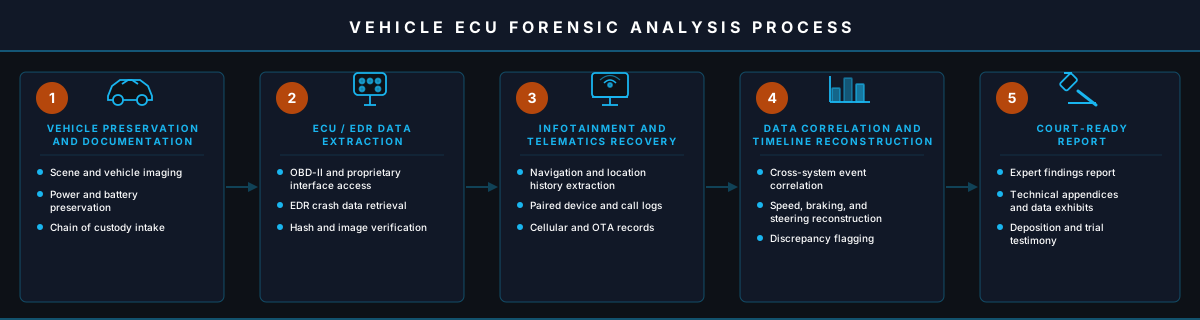
GDF uses the Bosch Crash Data Retrieval (CDR) tool as the primary platform for EDR data extraction. CDR is the industry-standard tool accepted in courts nationwide, developed in partnership with NHTSA and the National Association of Professional Accident Reconstruction Specialists (NAPARS). The CDR system connects to the vehicle's OBD-II diagnostic port, communicates with the airbag control module or dedicated EDR using the vehicle-specific diagnostic protocol, retrieves stored event records, and decodes them into a standardized report format.
GDF documents the complete download procedure: vehicle identification (VIN, year, make, model), CDR tool software version, module identification data reported by the vehicle, the number of events retrieved, and hash verification of the data file. The CDR report is presented as-extracted without modification, with GDF's analysis provided in a separate expert report that interprets the findings in the context of the matter at issue.
For vehicles not supported by CDR, GDF uses manufacturer-specific diagnostic platforms, third-party vehicle forensics tools, or direct ECU communication methods to retrieve available event data. Coverage and data element availability vary by make, model, and model year.
Infotainment System Forensics
Vehicle infotainment systems have become among the most data-rich sources in vehicle forensics. These systems function as the vehicle's primary human-machine interface, connecting to smartphones, storing navigation history, logging communication activity, and recording continuous GPS track data over periods ranging from weeks to months depending on storage capacity and data retention settings.
Berla iVe Platform
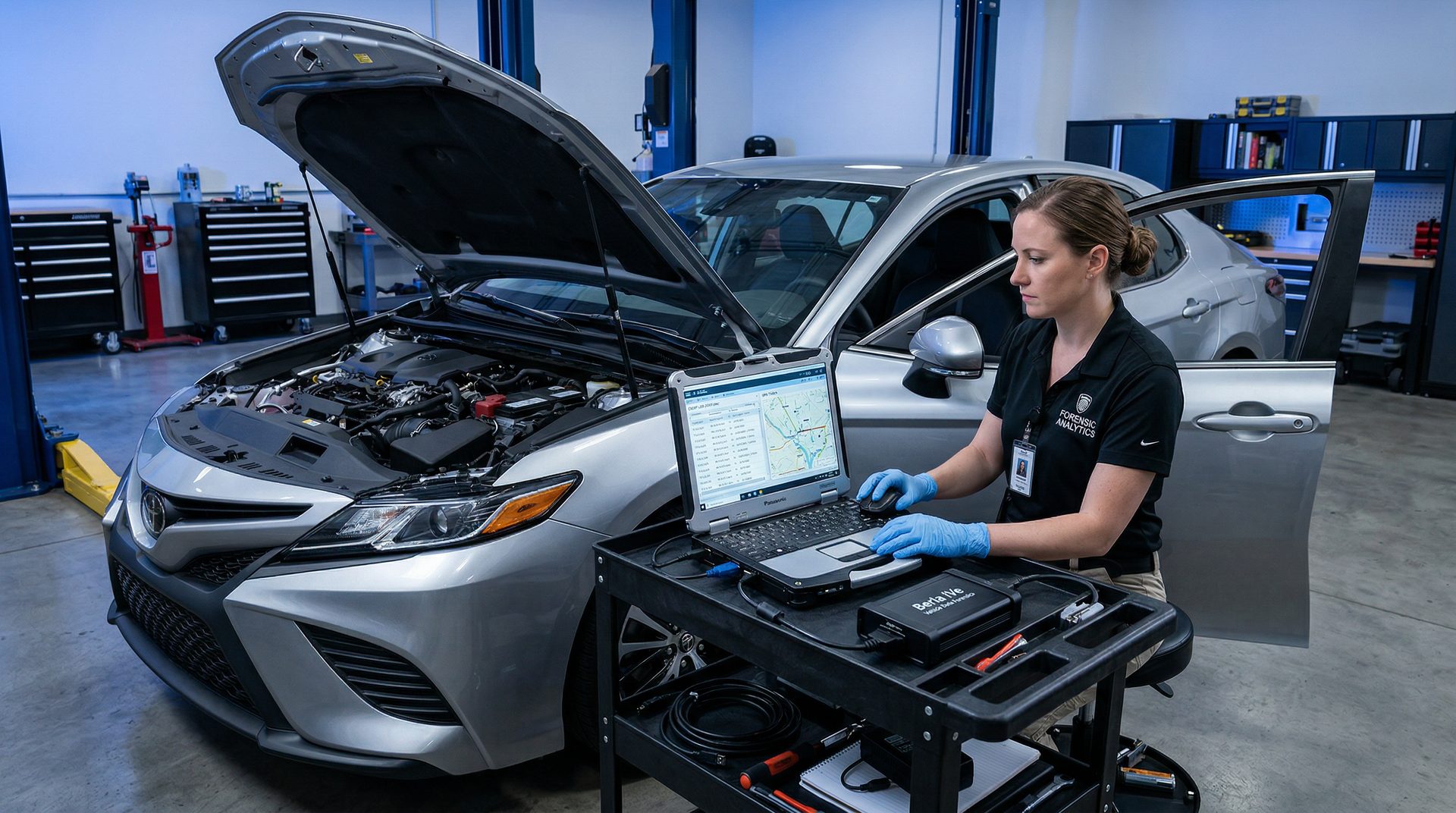
GDF uses the Berla iVe system, the premier vehicle systems forensics platform, to extract and decode infotainment data. Berla iVe supports more than 15,000 vehicle models and is updated continuously as new model years are released. The platform connects to the vehicle's OBD-II port or directly to the infotainment unit and extracts data using manufacturer-specific acquisition methods appropriate for each target system.
Recoverable infotainment data categories include:
- GPS navigation history: Destinations entered, routes searched, recent locations, home and work addresses, and in many systems a continuous GPS track log recording the vehicle's location and speed throughout every trip stored in memory
- Connected device records: Every mobile device paired with the vehicle via Bluetooth, including device name, device identifier (used to cross-reference with mobile device forensics), and connection and disconnection timestamps
- Call records: Hands-free calls made through the infotainment system, with caller/recipient numbers, call duration, and timestamps correlated to GPS position during the call
- SMS and message records: Text messages forwarded to and from the vehicle via Bluetooth phone connections in vehicles with message notification features
- Wi-Fi history: Networks the vehicle has connected to, with network names and connection timestamps
- Media and application records: Streaming service account connections, media file names, and application usage history depending on the infotainment platform
- Vehicle configuration and odometer history: Trip data, fuel consumption records, and maintenance records stored by the vehicle's onboard computer
Correlation with Mobile Device Evidence
One of the most powerful capabilities of infotainment forensics is the cross-referencing of vehicle data with mobile device data. Bluetooth pairing records in the vehicle identify which devices were connected at specific times. The corresponding mobile device records, recovered through GDF's mobile device forensics practice, document what those devices were doing during the same period. The combination establishes not only that a phone was in the vehicle at the time of a crash or other event, but what applications were active, whether the driver was communicating, and what specific messages or calls were occurring at the critical moment.
This correlation is particularly valuable in distracted driving cases. SAE J1698 documentation of vehicle-phone interfaces provides the technical framework for understanding when a phone is actively connected to the vehicle's hands-free system versus when the driver is manually operating the phone. Combined infotainment and mobile device analysis can distinguish between a call conducted through the vehicle's hands-free system (connected to the infotainment unit) and a call conducted on the phone directly (not reflected in the infotainment call log despite being in the same time window).
CAN Bus and ECU Deep Interrogation
The Controller Area Network (CAN) bus is the communication backbone that connects the dozens of electronic control units distributed throughout a modern vehicle. Engine control module, transmission control module, anti-lock brake module, body control module, climate control, lighting, door modules, and dozens of other ECUs communicate continuously over the CAN bus, broadcasting sensor readings, status information, and control commands.
CAN bus analysis captures and decodes this inter-ECU communication stream, providing a comprehensive record of vehicle system states at the network communication level. In forensic applications, CAN bus logging is most commonly applied through:
- Post-event analysis of stored CAN data: Some telematics modules and OEM data logging systems store CAN bus snapshots associated with detected events, providing vehicle-side records that complement EDR data
- Deep ECU interrogation: Direct communication with individual ECUs using OEM diagnostic protocols to retrieve stored diagnostic trouble code histories, operating parameter logs, and configuration data beyond what standard OBD-II interfaces expose
- Odometer and VIN tampering detection: ECU interrogation across multiple modules (instrument cluster, engine control module, transmission control module) to identify discrepancies in stored odometer values consistent with odometer fraud, which may require correlation with IC-level analysis of ECU memory
- Fault code history: Stored and pending diagnostic trouble codes that document system failures and anomalies before and after a loss event
GPS and Telematics Data Recovery
Vehicle GPS and telematics data covers two distinct sources: data stored within the vehicle's infotainment or embedded telematics module, and data stored in OEM or third-party cloud platforms that receives telemetry from the vehicle. Both sources provide location, speed, and trip information, but with different data retention windows and different legal process requirements for access.
Onboard Telematics Data
Most vehicles produced since approximately 2015 include an embedded telematics module that records GPS location, speed, and trip data onboard the vehicle. GDF extracts this data using Berla iVe and manufacturer-specific tools, recovering trip histories that typically span weeks to months depending on the module's storage allocation. Where the data has been partially overwritten by newer trips, data carving techniques applied to the module's storage may recover fragments of older trip records.
OEM Cloud Telematics
OEM connected services platforms (OnStar, FordPass Connect, BMW ConnectedDrive, Tesla's vehicle logs, and equivalents) collect continuous telemetry from equipped vehicles and store it in cloud infrastructure. This data is not stored in the vehicle itself and must be obtained through legal process directed to the OEM. GDF assists attorneys in identifying the specific OEM telematics platform involved, the data elements that platform collects and retains, and the appropriate legal process for obtaining the data. GDF then processes the produced data and presents it in formats suitable for use in litigation.
Fleet and Usage-Based Insurance Telematics
Commercial fleet vehicles equipped with fleet management telematics devices and personal vehicles enrolled in usage-based insurance programs generate detailed trip-by-trip records including GPS tracks, speed histories, hard braking events, acceleration patterns, and idling records. These records are stored by the fleet management or insurance telematics provider and are available through legal process. GDF's analysis of fleet telematics data provides a comprehensive history of vehicle operations over extended periods, relevant to accident reconstruction, driver behavior patterns in employment disputes, and fleet management liability matters.
Use Cases and Applications
Accident Reconstruction for Law Firms
Vehicle forensics data has substantially changed the evidentiary picture in motor vehicle accident litigation. Attorneys on both sides of personal injury and wrongful death cases now routinely seek EDR, infotainment, and telematics data as part of standard discovery. GDF provides vehicle forensics support to plaintiff and defense attorneys, extracting and presenting the available digital evidence from the vehicles involved and providing expert opinions on what that evidence shows about vehicle dynamics, driver actions, and vehicle system performance in the period preceding and during the crash event.
GDF's accident reconstruction support includes EDR data download and report preparation, infotainment GPS track extraction and mapping, mobile device correlation analysis (distracted driving), and expert witness testimony explaining the technical findings to juries. For complex reconstruction matters, GDF coordinates with accident reconstruction engineers who use the digital vehicle data as inputs to their physical reconstruction analyses.
Insurance Fraud Detection
Vehicle insurance fraud takes several forms that digital vehicle forensics can address directly. Staged accident fraud involves deliberately causing or fabricating collisions: EDR data showing speed, braking, and throttle profiles inconsistent with the claimed accident scenario, combined with GPS records showing the vehicle's position relative to the claimed loss location, provides objective evidence against fraudulent claims. Odometer fraud in used vehicle sales is detectable through multi-module ECU interrogation. Vehicle theft fraud can be addressed through telematics data showing the vehicle's actual movements before and after the alleged theft date.
GDF works with insurance carriers, third-party administrators, and special investigative units to provide vehicle forensics analysis in support of claim evaluation, SIU referrals, and civil proceedings against fraudulent claimants. GDF performs all analysis under proper legal authorization and documented in reports structured to address the specific coverage and fraud questions relevant to each claim.
Civil Litigation: Driver Behavior Documentation
Beyond accident reconstruction, vehicle forensic data serves a range of civil litigation needs. In commercial truck accident litigation, ECU and electronic logging device (ELD) data documents Hours of Service compliance, trip timing, and driver behavior preceding the crash. In employment disputes involving company vehicles, GPS and infotainment data documents employee locations and activities during work hours. In divorce and domestic matters, vehicle location data corroborates or contradicts claims about movements and activities. In commercial disputes involving delivery vehicles, telematics data establishes whether deliveries were made as claimed and in what condition the vehicle was operated.
Vehicle Theft and VIN Recovery
Modern vehicle theft often involves electronic manipulation of vehicle systems: key programming attacks, CAN bus injection to bypass immobilizers, and ECU cloning to hide the vehicle's true identity. GDF's ECU interrogation capabilities support vehicle theft investigations by recovering stored VIN data from multiple ECU modules (which must all agree for an authentic vehicle), identifying programming artifacts from unauthorized key additions, and recovering deleted or modified VIN records from infotainment and navigation systems that store the vehicle identifier independently of the primary ECU.
Professional Standards
GDF's automobile forensics practice operates under recognized standards for vehicle data collection and digital evidence handling:
- NHTSA 49 CFR Part 563: Federal regulation governing EDR data elements, recording requirements, and data format for compliant vehicles, providing the definitive technical reference for EDR data interpretation
- SAE J1698: Society of Automotive Engineers standard for Vehicle Event Data Interface, governing communication between vehicle systems and external diagnostic tools
- SWGDE Best Practices for Digital Evidence: Scientific Working Group on Digital Evidence guidelines for acquisition, examination, and documentation of digital evidence, applied throughout GDF's vehicle forensics workflow including chain of custody, write protection, and hash verification
- ISO/IEC 17025 principles: Quality management principles for testing laboratory operations governing GDF's examination documentation and result verification processes
- NIST OSAC Vehicle Forensics Standards: GDF monitors the National Institute of Standards and Technology Organization of Scientific Area Committees (OSAC) vehicle forensics subcommittee for developing standards in this area
Ready to Discuss Your Case?
All consultations are strictly confidential. Contact us to discuss your vehicle electronics forensic analysis needs.
Last updated: April 16, 2026
EDR and CDR Downloads
- Bosch CDR tool, NHTSA 49 CFR Part 563 compliant
- Speed, braking, throttle, and seatbelt pre-crash data
- Multi-event recording analysis
- Hash-verified download with chain of custody
Infotainment Extraction (Berla iVe)
- 15,000+ vehicle model support
- GPS track history and navigation records
- Paired device records and call logs
- SMS and messaging artifacts
CAN Bus and ECU Interrogation
- Deep ECU parameter and fault code retrieval
- Odometer and VIN discrepancy detection
- Telematics module data extraction
- CAN bus event log analysis
Litigation Support
- Accident reconstruction data support
- Insurance fraud vehicle data analysis
- Mobile device correlation for distracted driving
- Expert witness testimony nationwide
Request a Vehicle Forensics Consultation
Vehicle forensic data can be overwritten as the vehicle continues to be driven. Prompt action maximizes the data available for analysis. GDF is available 24/7 for urgent matters.