

Mobile Device Forensics
Smartphones hold more relevant evidence than almost any other digital artifact in modern litigation and corporate matters. GDF's certified mobile device forensic analysts apply physical, file system, and logical extraction methods to recover and preserve data from iPhones, Android devices, tablets, and wearables, producing court-admissible reports for attorneys, corporations, and insurance professionals nationwide.
Why Mobile Device Evidence Matters
The average smartphone user sends dozens of messages, makes multiple calls, shares location data, and accesses cloud-connected applications every day. That continuous stream of activity creates a detailed record of communications, movements, relationships, and decisions that is often far more comprehensive than anything found on a desktop computer. In civil litigation, criminal defense, corporate internal matters, and insurance claims, mobile device data has become a primary category of digital evidence.
The challenge is that mobile devices are not designed with forensic access in mind. Modern iPhones and Android flagship devices implement full-disk encryption, secure enclave processors, and sophisticated boot verification that can make unauthorized data access effectively impossible without the correct credentials or specialized forensic techniques. At the same time, the volume of data smartphones store, spanning native applications, third-party apps, encrypted messaging platforms, and synchronized cloud services, demands systematic collection and processing to produce findings that are complete, accurate, and defensible under cross-examination.
GDF's mobile device forensics practice combines certified examiners, validated extraction tools, and documented methodology aligned with NIST SP 800-101 Rev. 1 and SWGDE best practices. Every examination begins with proper device isolation to prevent remote wiping, proceeds through a documented chain of custody, and concludes with a written report that attorneys can rely on to support motions, depositions, and trial. For matters where mobile data intersects with broader digital evidence, GDF's computer forensics and IT forensics teams can work in coordination.
Extraction Methods and Tool Platforms
No single extraction method works for every device or every matter. GDF's examiners select the appropriate extraction approach based on the device model, operating system version, security configuration, and the scope of evidence needed. The three primary extraction tiers are logical, file system, and physical, each offering different levels of data access and completeness.
Logical Extraction
Logical extraction communicates with the device through its normal operating system interfaces, retrieving data that the device presents through standard APIs. This approach is the least invasive and works on most locked and unlocked devices. Logical extraction typically recovers:
- Contacts, call history, and voicemail
- SMS and MMS message content
- Emails and calendar entries
- Photos, videos, and audio files accessible through the media library
- Application data exposed through backup interfaces
- Device identifiers including IMEI, serial number, and linked account information
Logical extraction does not access deleted data or the unallocated storage regions where deleted content may remain recoverable. For many litigation matters, however, logical extraction of intact data is sufficient to address the key questions at issue, and it carries the least risk of device alteration or challenge to admissibility.
File System Extraction
File system extraction acquires the complete file system of the device, including application sandboxes, system databases, and data not exposed through standard backup interfaces. This method accesses significantly more data than logical extraction, including application-level databases that store message content, transaction logs, and behavioral records for hundreds of commonly used apps. File system extraction frequently recovers recently deleted files and database records that the operating system has marked as deleted but not yet overwritten.
GDF performs file system extractions using Cellebrite UFED and Magnet AXIOM, both of which include application-specific decoders that parse the raw database records produced by thousands of applications into readable, timestamped records. This parsing is critical for producing usable evidence from apps like WhatsApp, Signal (where accessible), Snapchat, Instagram, and banking and financial applications that store data in proprietary database schemas.
Physical Extraction
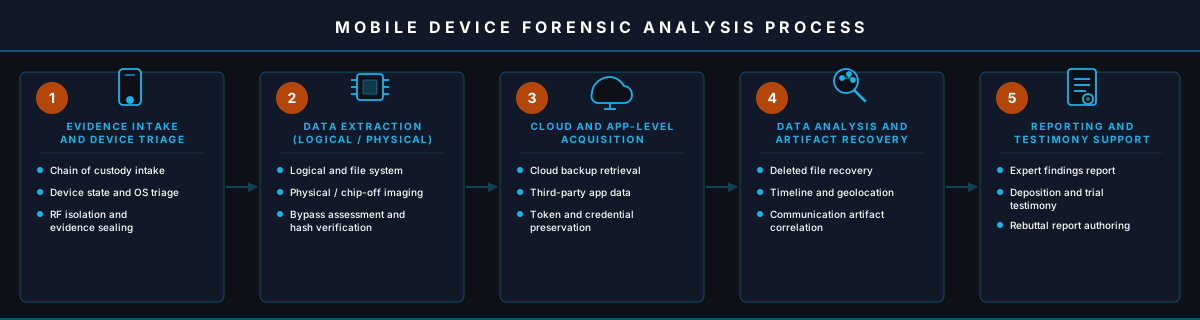
Physical extraction produces a bit-for-bit image of the device's storage chip, capturing every sector including unallocated space where deleted data may be recoverable through data carving techniques. This is the most comprehensive extraction method and the one most likely to recover deleted messages, call records, images, and application data. Physical extraction requires bypassing device security protections and is not available for all device models and operating system versions.
For devices where software-based physical extraction is not available, GDF's laboratory capabilities include chip-off extraction: physically removing the storage chip from the device and reading it directly with a compatible chip reader. Chip-off is a destructive technique reserved for devices that are damaged, locked, or otherwise inaccessible through software methods. GDF's chip-off examiners use this capability in coordination with the requesting attorney to ensure that the decision to proceed is documented and legally defensible.
Physical extraction findings are processed with Cellebrite UFED Physical Analyzer and Magnet AXIOM to parse recovered data, reconstruct timelines, and identify artifacts across multiple application databases that cross-reference each other.
Tool Platforms
GDF's mobile forensics laboratory uses a validated toolkit aligned with SWGDE minimum requirements for mobile forensic tool testing:
- Cellebrite UFED: Industry-standard physical and logical extraction for thousands of device models, with UFED Cloud Analyzer for authorized cloud account extraction
- MSAB XRY: Independent extraction and analysis platform with strong coverage of non-flagship and international device models
- Magnet AXIOM: Comprehensive artifact recovery and analysis across mobile, computer, and cloud sources, with timeline reconstruction and cross-source correlation
- Oxygen Forensic Detective: Extraction of data from over 35,000 device models with cloud service integration for authorized account acquisition
- GrayKey (where applicable): Lawful access to encrypted iOS devices in conjunction with appropriate legal process
All tools are validated per SWGDE and NIST guidelines. Hash verification using SHA-256 confirms the integrity of every acquisition before analysis begins.
Chain of Custody and Evidence Integrity
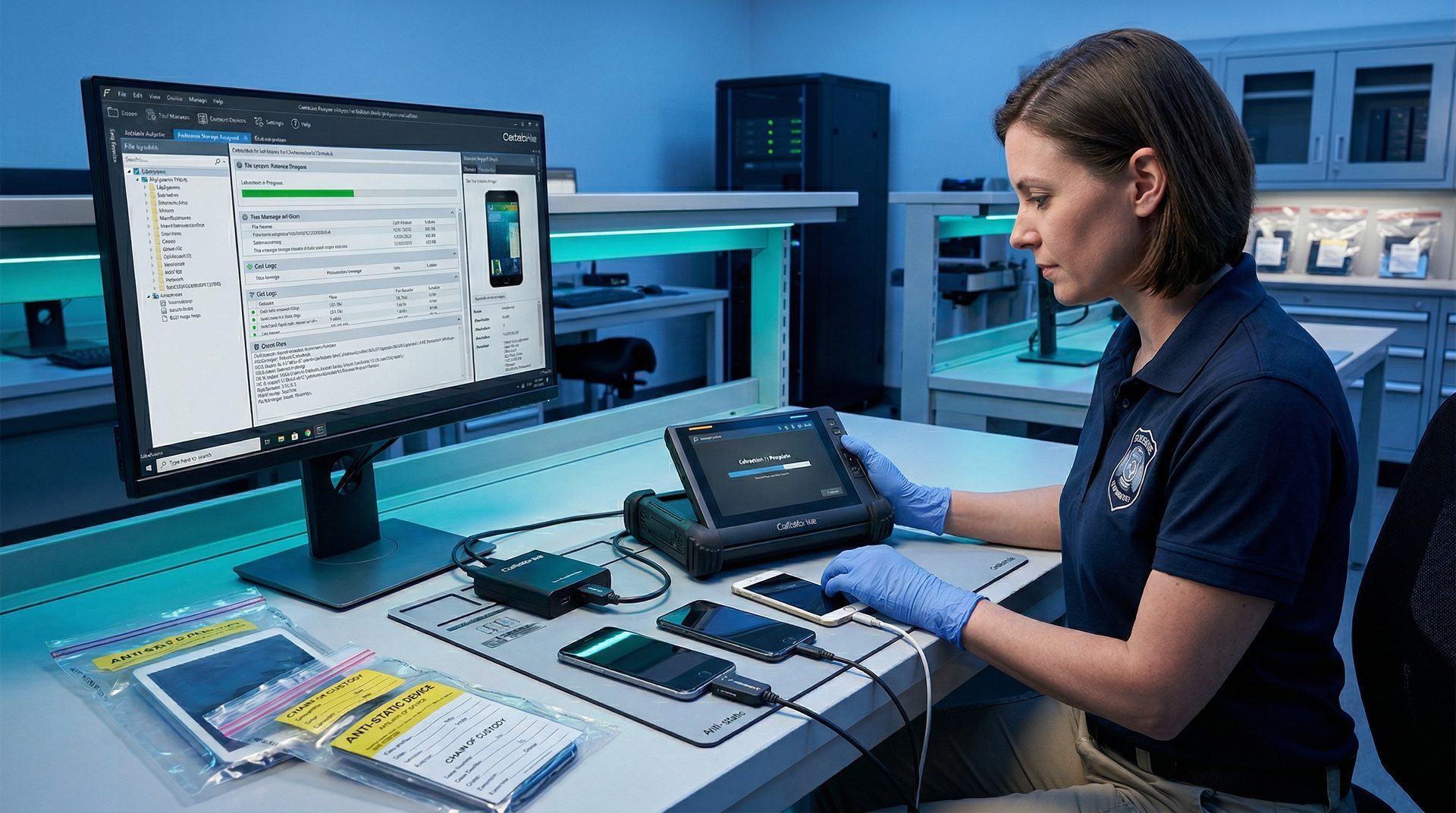
The forensic value of mobile device evidence depends entirely on the ability to demonstrate an unbroken chain of custody from the moment the device is received through every step of examination to the delivery of findings. GDF's examination procedures document every contact with evidence: receipt, isolation, storage, extraction, analysis, and reporting. Each device is assigned a unique evidence number, photographed on intake to document its condition, and stored in a secure, access-controlled evidence room.
Faraday shielding is applied at intake to prevent cellular, Wi-Fi, and Bluetooth communications that could allow remote wiping, remote lock, or data modification before extraction begins. Where Faraday bags are not sufficient for the extraction environment, GDF places devices in airplane mode with confirmatory documentation, or uses a Faraday cage during the extraction process.
Hash values are generated for every acquisition before and after extraction to confirm that the forensic copy is an exact, unaltered duplicate of the original. All examination notes, tool output logs, and hash verification records are preserved as part of the case file and are available for review by opposing counsel or court-appointed experts. GDF's chain of custody documentation meets the standards required for admission under Federal Rule of Evidence 901 and equivalent state rules.
Categories of Recoverable Evidence
Modern smartphones accumulate a remarkably detailed record of their user's activities. GDF's mobile forensic examinations can recover and present the following categories of data, subject to device accessibility and the time elapsed since deletion or modification:
Communications and Messaging
- SMS and MMS messages with timestamps, sender and recipient identifiers, and message thread context
- iMessage and FaceTime records from iOS devices
- WhatsApp, Telegram, and Signal message databases (where accessible based on encryption and device access)
- Facebook Messenger, Instagram direct messages, and Snapchat chat logs from cached and database artifacts
- Email from native mail clients and cached webmail content
- Voicemail recordings and call logs with duration and tower data
Location and Movement Data
- GPS coordinates from photos (EXIF metadata), mapping applications, and fitness tracking apps
- Wi-Fi access point connection history with timestamps and approximate location
- Cell tower connection records from device logs
- Application location history from Google Maps, Apple Maps, Uber, Lyft, and similar services
- iOS Significant Locations database recording frequently visited places with timestamps
Financial and Transaction Records
- Banking application cached transaction records
- Venmo, PayPal, Cash App, and Zelle transaction artifacts
- Cryptocurrency wallet application records and transaction histories
- Purchase receipts and order confirmations from email and application caches
Media and Documents
- Photos and videos with EXIF timestamps and geolocation
- Deleted media recoverable from unallocated storage
- Screenshots, screen recordings, and document scans
- Cloud-synced documents from iCloud Drive, Google Drive, and OneDrive
Device and Application Activity
- Application usage logs showing which apps were open and when
- Browser history, bookmarks, and cached web content
- Search queries and autocomplete history
- Notification history and system event logs
- Device pairing records for Bluetooth accessories, including connected vehicles and wearables
Cloud Forensics for Mobile-Linked Accounts
Mobile devices are increasingly thin clients for cloud-stored data. Many users store photos in iCloud or Google Photos, sync messages through iCloud Backup or Google One, and access work documents through Microsoft 365 or Google Workspace applications on their phones. When a device itself is inaccessible, damaged, or has been wiped, cloud extractions may provide access to much of the same data that would have been obtained from the device.
GDF performs cloud extractions under proper legal authorization using Cellebrite UFED Cloud Analyzer and Oxygen Forensic Detective. Recoverable cloud data includes full iCloud backups, iCloud Drive contents, iCloud Photos, Google Drive and Photos, Samsung Cloud backups, and application-specific cloud storage for services including WhatsApp, Snapchat, and major social media platforms. Each cloud extraction is documented with the legal authorization under which the examiner collected it, the specific data categories requested and received, and hash verification of the extracted content.
Cloud forensics also extends to carrier records. Call detail records (CDRs) obtained through legal process from cellular carriers provide a carrier-side record of calls, SMS, and data sessions that can corroborate or supplement device-extracted data. GDF assists attorneys in identifying and framing appropriate legal process for carrier record requests as part of a coordinated mobile evidence strategy.
Litigation Support and Use Cases
GDF's mobile device forensics practice serves attorneys, corporations, and insurance professionals across litigation, corporate investigations, and insurance matters. Each engagement is structured to address the specific questions that the requesting party needs to answer, and findings are presented in the format most useful for the intended proceeding.
Civil Litigation Support for Law Firms
Mobile device evidence is now routine in civil litigation across practice areas. Family law attorneys use smartphone data to establish communication patterns, financial transfers, and location history relevant to divorce, custody, and asset concealment matters. Employment attorneys rely on mobile forensics to document communications between employees and competitors in trade secret and non-compete disputes. Personal injury attorneys extract driving behavior and distracted driving evidence from smartphone applications and vehicle-connected Bluetooth records. GDF provides litigation support examiners who can prepare written reports, assist in drafting discovery requests, and testify as expert witnesses in deposition and at trial.
Corporate IP Theft and Employee Misconduct
When an employee departs with trade secrets, client lists, or proprietary data, their corporate and personal mobile devices often hold the clearest record of what was taken and where it went. GDF's corporate mobile forensics examinations document file transfers, cloud upload activity, messaging with competitors or new employers, and app-by-app data access patterns that establish what the departing employee accessed before their departure. This analysis supports injunctive relief applications, breach of contract claims, and criminal referrals for trade secret theft under the Defend Trade Secrets Act.
For corporate internal matters, GDF works under attorney-client privilege through outside counsel to provide findings that support HR decisions, compliance documentation, and corporate litigation holds. For connected corporate investigations involving network activity, GDF's network forensics team can analyze network logs alongside mobile device findings to build a complete picture of data movement.
Insurance Claims
Mobile device forensics is a valuable tool for insurance claim evaluation in several contexts. In vehicle accident claims, smartphone data can establish whether the insured or claimant was using their phone at the time of the collision, through application activity timestamps, GPS records, and Bluetooth pairing logs with in-vehicle systems. In workers' compensation matters, location data and communications can corroborate or contradict claimed injury circumstances. In fraud matters, mobile forensics can identify inconsistencies between claimed events and the digital record documented in the claimant's own device.
Professional Standards and Certifications
GDF's mobile device forensics practice is governed by recognized professional standards that ensure examination quality and support court admissibility:
- NIST SP 800-101 Rev. 1: NIST's Guidelines on Mobile Device Forensics provide the technical foundation for GDF's examination procedures, covering preservation, acquisition, examination, and reporting requirements
- SWGDE Best Practices: The Scientific Working Group on Digital Evidence publishes best practices for mobile device forensic analysis, evidence collection, preservation, handling, and acquisition that GDF follows as baseline standards
- SWGDE Minimum Requirements for Testing: GDF validates all extraction tools against SWGDE minimum requirements, documenting tool performance for specific device models and OS versions used in each case
- ISO 17025 principles: GDF's laboratory procedures incorporate quality management principles consistent with ISO 17025, covering documentation, method validation, and result verification
GDF mobile device examiners hold Cellebrite Certified Mobile Examiner (CCME), Cellebrite Certified Operator (CCO), and Cellebrite Certified Physical Analyst (CCPA) credentials. These certifications validate proficiency with the most widely deployed mobile forensics platform and are recognized by courts as evidence of examiner competence.
Expert Reports and Testimony
A forensic examination produces its value through a report that attorneys and courts can understand and rely on. GDF's mobile forensic reports are structured to address specific evidentiary questions, present findings in clear non-technical language with supporting technical documentation, and withstand the scrutiny of opposing expert review.
Each report identifies the devices examined, the extraction method used, the tools and tool versions applied, and the hash values confirming acquisition integrity. Findings are organized by evidentiary category: communications, location data, financial records, file transfers, and application activity. Timeline exhibits present key events in chronological order for use as demonstratives in depositions and at trial.
GDF examiners are available to testify as expert witnesses in federal and state court proceedings, arbitrations, and administrative hearings. Expert witness engagements include review of opposing expert reports, preparation of rebuttal analysis, and preparation for deposition. GDF has provided expert testimony in matters across commercial litigation, criminal defense, family law, and employment disputes in jurisdictions throughout the United States.
Anti-Forensic Techniques and Counter-Analysis
Sophisticated parties to litigation increasingly attempt to use anti-forensic techniques to defeat mobile device examination. Common approaches include remote wiping via iCloud Find My or Google Find My Device, factory resets performed before device surrender, selective message deletion, use of self-destructing messaging applications, and encryption of application data with user-controlled keys. GDF's examiners are trained to recognize the artifacts that anti-forensic activity leaves behind.
Factory resets and remote wipes create distinctive patterns in system logs and unallocated storage that identify when they occurred and, in many cases, what data was present before the reset. Application usage logs and notification caches frequently survive resets or contain records of pre-reset application activity. Carrier records provide a device-independent record of communications that device-side deletion cannot affect. GDF's approach to suspected anti-forensic activity is to document the artifacts of that activity as evidence in its own right, supporting spoliation motions and adverse inference arguments in litigation.
Ready to Discuss Your Case?
All consultations are strictly confidential. Contact us to discuss your mobile device forensic analysis needs.
Last updated: April 16, 2026
Physical and Chip-Off Extraction
- Bit-for-bit physical acquisition of device storage
- Deleted data recovery via data carving
- Chip-off capability for damaged or inaccessible devices
- Cellebrite UFED and Magnet AXIOM analysis
Cloud and Carrier Data
- iCloud, Google, and Samsung Cloud extractions
- Authorized WhatsApp and social platform cloud acquisition
- Carrier CDR legal process support
- Oxygen Forensic Detective cloud integration
Litigation-Ready Reporting
- Chain of custody documentation for admissibility
- NIST SP 800-101 Rev. 1 compliant procedures
- Timeline exhibits for deposition and trial
- Expert witness testimony nationwide
Corporate and Insurance Support
- Employee misconduct and IP theft analysis
- Attorney-client privileged engagements
- Insurance fraud mobile evidence review
- Distracted driving app and Bluetooth analysis
Request a Mobile Forensics Consultation
All consultations are strictly confidential. GDF works directly with attorneys and corporate counsel to structure examinations that meet litigation requirements and evidentiary standards.